Region Discovery
Region Discovery answers a section-level question: did the predictor recover the right coding runs, independent of fine-grained boundary residuals?
How Sections Are Matched
The benchmark first extracts contiguous GT and predicted coding sections. It
then finds all overlapping (GT, pred) pairs and sorts them by overlap
length. A greedy 1:1 assignment claims the largest overlaps first.
perfect_boundary_hit is different: it uses a sweep over all sections and
counts any exact-boundary match, without the 1:1 assignment.
Output Structure
Region Discovery produces four precision/recall tiers that nest by strictness:
neighborhood_hit ⊇ { internal_hit , full_coverage_hit } ⊇ perfect_boundary_hit
Tier |
TP criterion |
Question answered |
|---|---|---|
|
matched pair overlaps at all |
Did we detect the region? |
|
prediction lies within GT ( |
Detected, but under-extended? |
|
prediction spans GT ( |
Detected, but over-extended? |
|
both boundaries exact |
Did we reproduce exact boundaries? |
Every tier is a coherent contingency table: TP + FN = total GT and
TP + FP = total pred. internal_hit and full_coverage_hit are inclusive
of an exact match, so a perfect pair counts toward both — that is what makes
the nesting hold.
False positives — the same rule for every tier
Each tier books its FP as total_pred − that-tier's hits. A matched pair that
fails a tier’s spatial test counts as both an FP (the prediction is not a
hit for this tier) and an FN (the GT is not hit for this tier). This is the
standard Burset/Eval exon-level behavior, and it is what makes precision and
recall well-defined at every level of strictness — the whole family reads as
one precision/recall ladder.
The Four P/R Tiers
neighborhood_hit
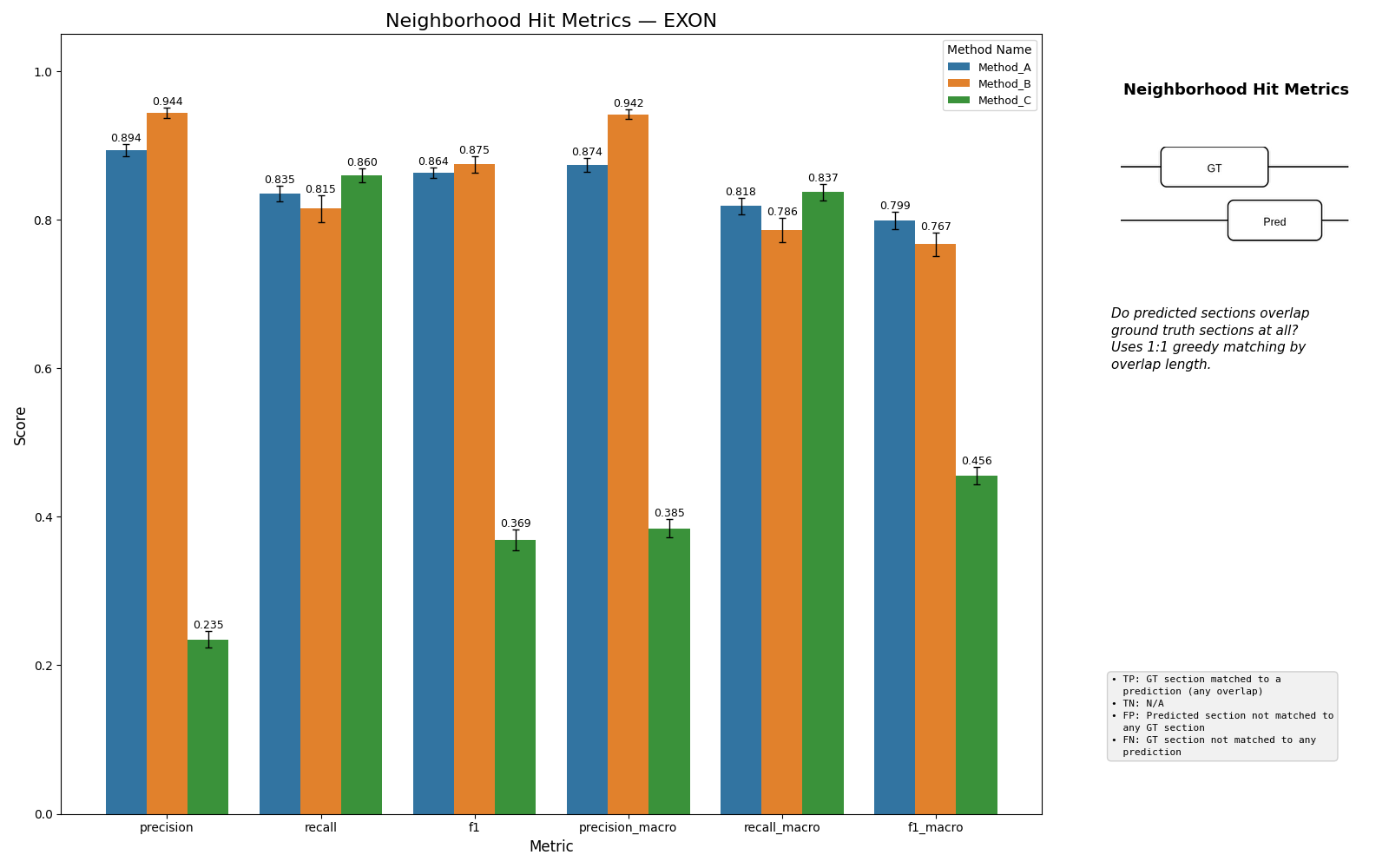
TP if the matched prediction overlaps the GT section at all. The most forgiving detection tier — any contact counts.
internal_hit
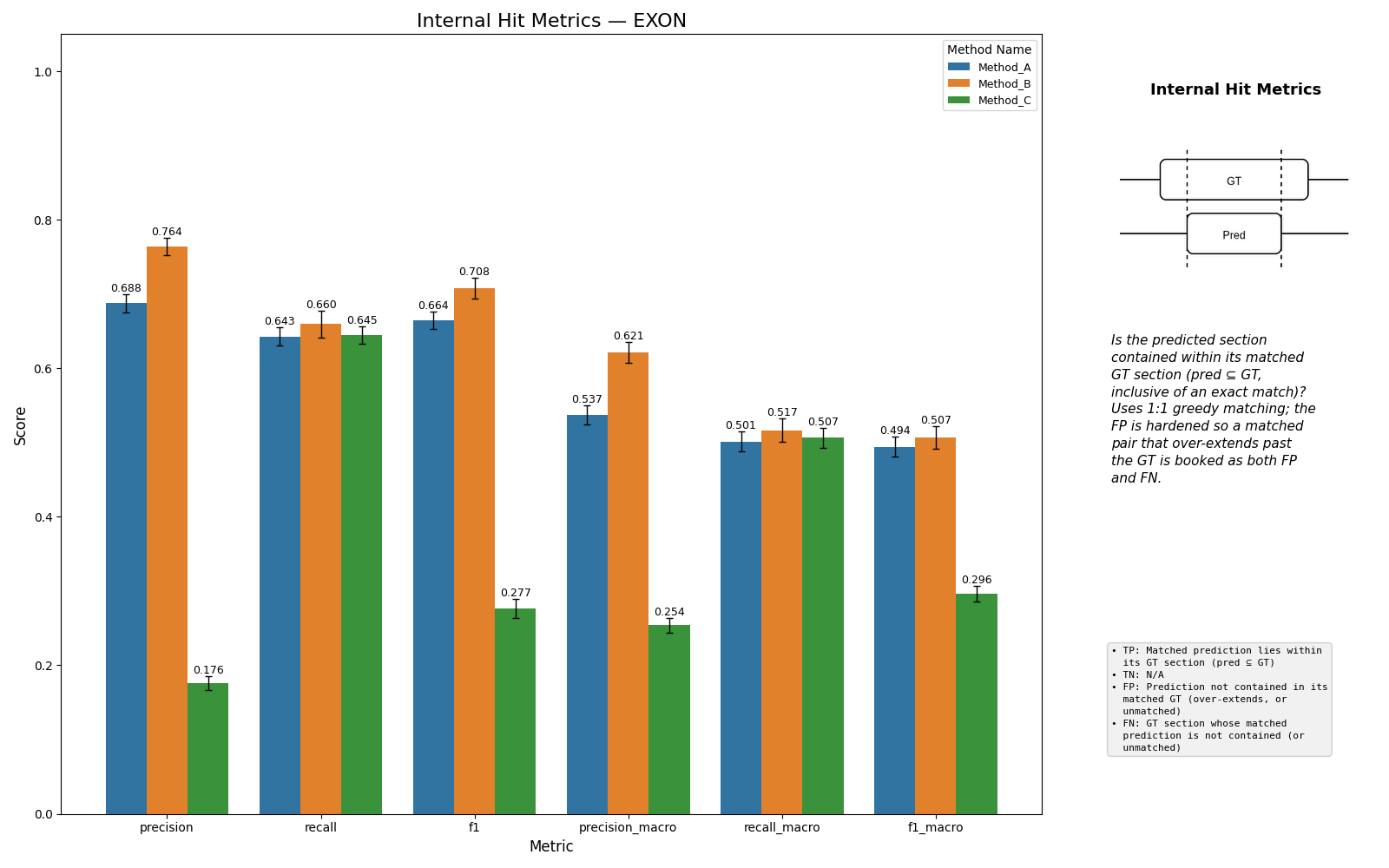 TP if the matched prediction lies within its GT section (
pred ⊆ GT, inclusive
of an exact match) — i.e. the prediction did not over-run the GT boundaries. A
matched pair that over-extends past the GT is an FP (and its GT an FN).
full_coverage_hit
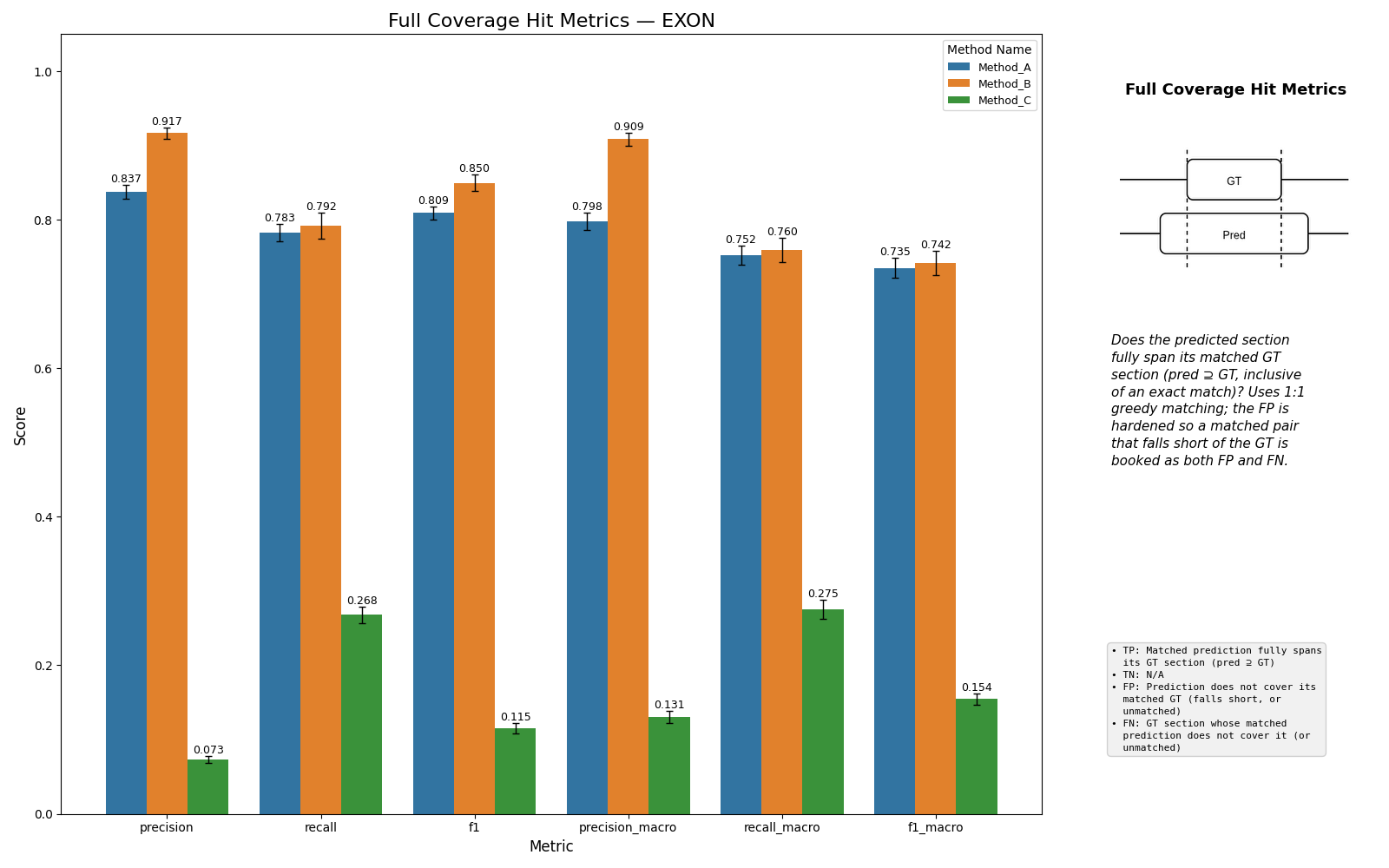
TP if the matched prediction fully spans its GT section (pred ⊇ GT, inclusive
of an exact match) — i.e. the prediction did not fall short of the GT
boundaries. A matched pair that falls short is an FP (and its GT an FN).
internal_hit and full_coverage_hit give the direction of the boundary
error: contrast their recalls to read under- vs over-extension.
perfect_boundary_hit
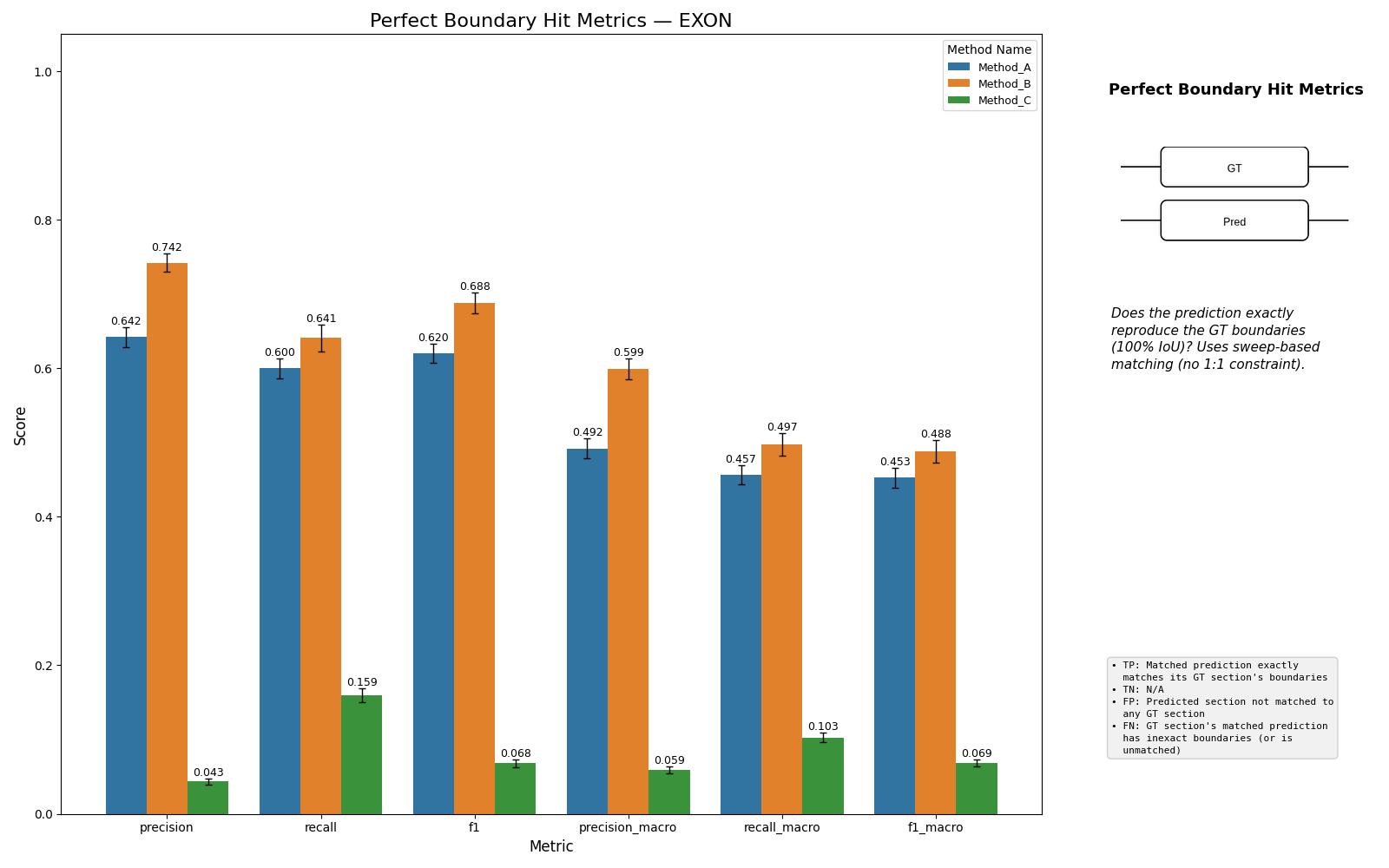
TP only when both boundaries match exactly. Unlike the other tiers this is sweep-based rather than 1:1 matched, which prevents fragmented predictions from being miscounted purely because one fragment already claimed a GT section in the greedy assignment.
Double-Penalty Behavior
All tiers intentionally treat GT sections and prediction sections as separate objects. When one GT section is split into two predictions, or two GT sections are merged into one prediction, you often get both a false negative on the GT side and a false positive on the prediction side. That is the right behavior if you want structural section recovery rather than base-level overlap alone.
Interpretation
high
neighborhood_hitrecall, lowperfect_boundary_hitrecall: the model usually finds the right locus but misses exact boundarieshigh
internal_hitrecall, lowfull_coverage_hitrecall: predictions tend to be too short (under-extended)low
internal_hitrecall, highfull_coverage_hitrecall: predictions tend to be too long (over-extended)both
internal_hitandfull_coverage_hitrecall nearneighborhood_hit: matched predictions are close to exact even whenperfect_boundary_hitis lower (a fragmentation effect)
Caveats
These metrics are coding-section metrics. They do not use intron labels.
They are not transcript-chain metrics. Two transcripts can have good section discovery while still failing strict structural coherence.
perfect_boundary_hitTP/FP/FN counts come from the sweep, so absolute counts are not directly comparable to the 1:1-matched tiers.Aggregation is micro-averaged across sequences (see Conventions): per-sequence integer counts are summed before ratios are computed, so long sequences dominate the corpus score.